By James Fire
SECTION ONE -
SAME OL’ SAME OL’ –
The title of this series reveals my view of the Emergent Church Movement (ECM) as being the same old, tired doubt and denigration of God’s Word that has been occurring in our world ever since the garden of Eden when the Serpent first said, “Yea, hath God said . . .?” but has returned in our day with new vigor and ambition.
The Gnostics proposed the same question.
Various esoteric societies revealed in the world for these many centuries have asked the same question.
Religious Institutions that have sought to usurp the authority of God’s Word with their own dogma and traditions have aggressively asked this same question (Like the Roman Catholic religion which we touched on in part One).
The liberal so-called Higher Critics and Bible scholars of the 19th and 20th centuries (we took a brief look at these in part One) have raised this same question.
And now we have the same question regurgitated by these Emergent Church advocates and leaders.
Read more!
 By James Fire
PRELIMINARY INTRODUCTION and EXAMINATION –
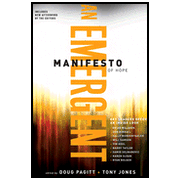
A few months ago I was perusing the site, Christian Book Distributors (CBD) and discovered an Emergent book (sadly, lots of these on CBD these days) by Doug Pagitt and Tony Jones entitled An Emergent Manifesto of Hope, Baker Books, 2007. It comprises a series of articles (25 in number) written by various Emergent advocates and leaders.
Realizing that most of all our articles for TTUF and its associate sites that focus on the Emergent Church Movement are based on critiques, evaluations and information provided by other Christian discernment ministries, I decided to ‘go to the horses’ mouth’ as it were and examine one of these books for myself.
I purchased this book (retail price was $16.99, but I got it for a mere $3.99 – so I felt good about spending so little on it) and once it arrived, began to digest it (talk about some serious indigestion!).
Once I started, jotting notes and Scripture references in the margins (a rather easy task as this was a trade paperback with wide margins), I quickly understood that I would have to address a couple of issues before diving into my own critique of these Emergent folk.
~*First of all, we all recognize the fact that this movement didn’t spring up spontaneously, though it seems to have since the mid 90’s, with very little mention of it prior; there were formative influences and factors that led up to it, stretching back to the 19th century. This movement makes the claim that because we live in a ‘post-modern’ world, the church must therefore adapt its methods and means of relating to the world with an equally post-modern approach to the Gospel and Christianity in general. Obviously what preceded the post-modern paradigm was the Modernist movement.
Read more!
ReferenceTagging.tag();


 By James Fire